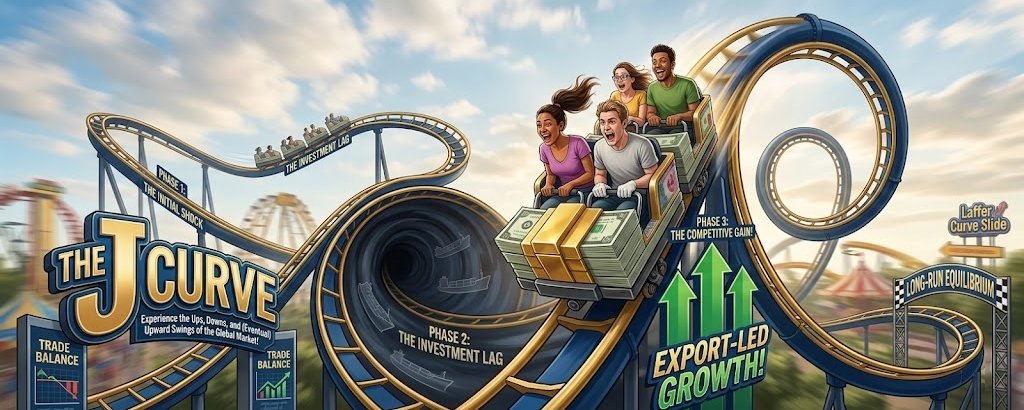

Nearly every transformational technology looks like a catastrophic blunder before it looks like a genius bet. Uber burned $32 billion. Tesla burned $9 billion. AI hyperscalers and LLM trainers are now on track to burn $500 billion.
This has fueled a tremendous amount of AI Doomerism. Even with 800 million weekly active users, how could ChatGPT ever earn back this kind of investment? But a look back at the history of truly disruptive startups and companies suggests that, counter-intuitively, OpenAI could be on track to do just that. But how?
Understanding the J-Curve
You've likely heard the expression “you have to spend money to make money.” This can be visually depicted on a chart as a “J-Curve.” At first, a company does not have customers, or even a finished product, so they're not generating revenue. Still, they have to spend capital... Developing their product, hiring staff, going out and finding customers, and so forth. Cumulative losses compound over time, and the line on the profitability chart dips down.
At SOME POINT (unless the company goes out of business), revenue kicks in, the product or service gets closer to product market fit, and it starts attracting exponentially more customers. Profit is assured. BUT the company is not free and clear yet; it's still in the hole from all those early expenditures, and must play catch-up.
Over a long enough timeline, that curve turns into a J. A big dip while the company takes in investment dollars or loans and spends it, then a gradual rise out of the pit and into financial success.
That big dip on the chart might look scary, but it's not a certain indication of inevitable collapse. Many great and successful companies have dropped into a dark void and then soared back out like the proverbial phoenix.
The Uber and Tesla Precedents
On TWiST, @Jason took a look back at two key examples from recent tech history: @Uber and @Tesla.
Uber's accumulated deficit peaked at around $32.8 billion in 2022. But that same year, the rideshare startup's free cash flow (FCF) -- the amount they had left over after spending all that they needed to run the business -- turned positive, to $0.4 billion. Today, Uber FCF is around $7 billion, and their accumulated deficit is down to just $10 billion.
Uber dug that hole in a number of ways, from expanding their infrastructure to building out a driver and rider network via subsidized rides. They were building a two-sided marketplace that did not exist until that point, and which now handles up to 30 million rides every single day.