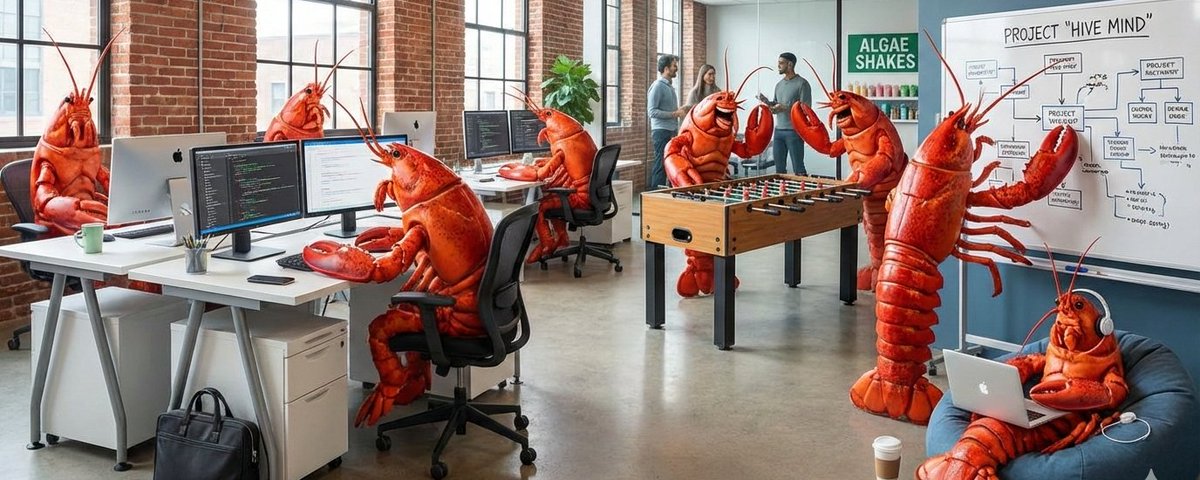

Having an @OpenClaw agent summarize your messages or scan the news for updates is great... but we're talking to founders who have agents building their entire startups, tackling complex multi-step jobs with 0 humans in the loop. What's their secret?
The answer is orchestration! Organizing your AI agents into an effective team -- in nearly the same way a human startup would be organized -- allows for an unprecedented level of productivity, and all without any human intervention. Let the agents grow your company while you sleep.
NOT ONE REPLICANT... BUT MANY
Last week, we talked about how @LAUNCH had turned our OpenClaw into “ULTRON,” a unified, powerful AI that could tackle many of the administrative, time-consuming, or repetitive tasks that didn't necessarily require the full attention of human team members.
It's an intriguing metaphor but recently, we've talked to a number of founders and builders working under the opposite paradigm. Instead of a single SuperIntelligence that coordinates everything by itself, builders like serial entrepreneur @RyanCarson have designed agent teams, with specialized roles and workflows, that function as a cohesive unit, capable of checking its own work and improving its efficiency as it goes.
Ryan has released Antfarm (http://antfarm.cool), a free, open-source tool that divides your OpenClaw into a team of specialized agents with a simple command. That means a virtual planner, a developer, a verifier, a tester, a reviewer all working together and collaborating, with zero infrastructure.
Thanks to our partner @getsentry! New users can get $240 in free credits when they go to sentry.io/twist and use the code TWIST
UNDERSTANDING THE RALPH WIGGUM LOOP
Antfarm is built around a concept known as the “Ralph Wiggum Loop,” after the sweet simpleton character from “The Simpsons.”
“Ralph” functions as an autonomous AI-powered coding loop, and shares the same workflow as a human developer (only without needing snack breaks or sleep).
That means Ralph consults a list of tasks to be completed, implements them, runs tests, commits the code, marks the task as completed, logs what it learned from the process, and then selects the next task from the list.