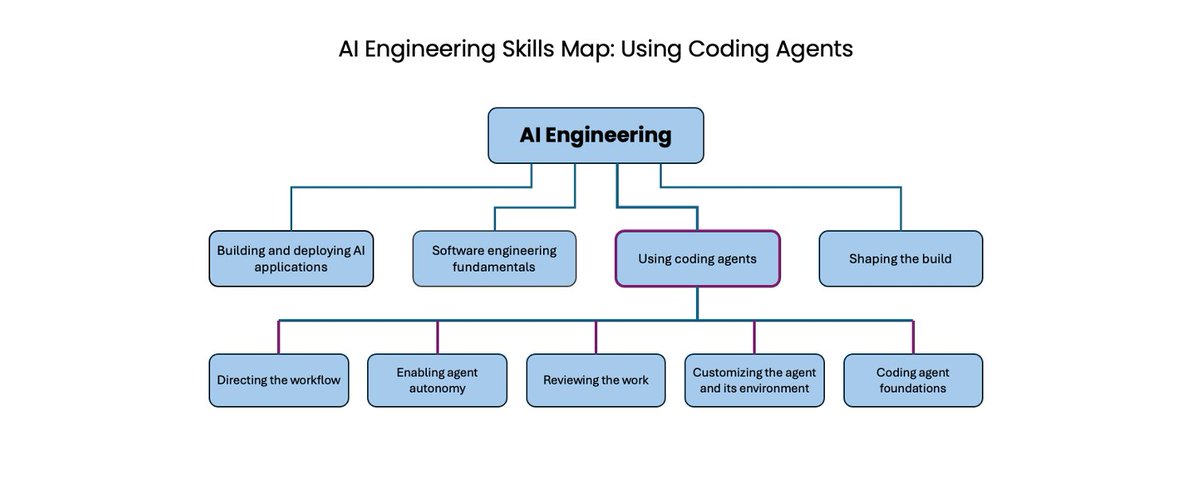

A key AI engineering skill is using coding agents. Your skill at steering them both to write code and to carry out non-code tasks, such as analyzing data or managing system operations, allows you to get a lot more done.
The rapid pace of evolution for coding agents means this skill, too, is evolving rapidly — faster than other top-level AI engineering skills. Proprietary agents (like Claude Code, Codex, and Cursor) and open agents (like OpenCode and Pi) progress in strides via both harness and model improvements. So keeping up with how to use coding agents requires a continuous process of experimentation, building, and learning.
In interviewing dozens of top AI Engineers and reflecting on our own team’s use of coding agents, we found a consistent high-level workflow for building software with them. The key steps are:
Planning. This includes (i) brainstorming, which may include research, experimentation, and understanding the existing codebase (if any) and (ii) writing a spec that captures requirements, technical design, and architecture, followed by generating an execution plan. You might also review the plan to interrogate key assumptions and check for security, overengineering, and other gaps.
Execution, where you build, test, and verify, with the right balance between agent autonomy and human oversight. This involves (i) having the agent build the software, with a calibrated level of agent autonomy and (ii) verifying its output via automated and/or human checks.
Deployment and monitoring, in which you (i) deploy, perhaps gated with a CI/CD pipeline or additional human gates, and (ii) use agents to watch logs, surface issues, and propose and execute improvements.
This high-level workflow is similar to the one typically used to build software before coding agents. Now, we focus much less on code and instead focus on deciding what to build, designing the architecture, writing the spec, and verifying outputs.
The duration of each step can vary significantly between projects, and steps can be omitted. For example, the spec for a greenfield (meaning built-from-scratch) prototype might be loosely described in a quickly written prompt, whereas the spec for a brownfield (pre-existing) project with many users might require much more effort to write and verify. Further, the workflow is highly iterative, and skilled developers know when feedback from a later step should lead them back to an earlier one. For example, if verification fails, they know how to steer the agent to rebuild and fix errors; or if monitoring surfaces issues, how to have agents update the system and redeploy.