Building a Personal AI Agent Team for Everyday Tasks
Press Space for next Tweet
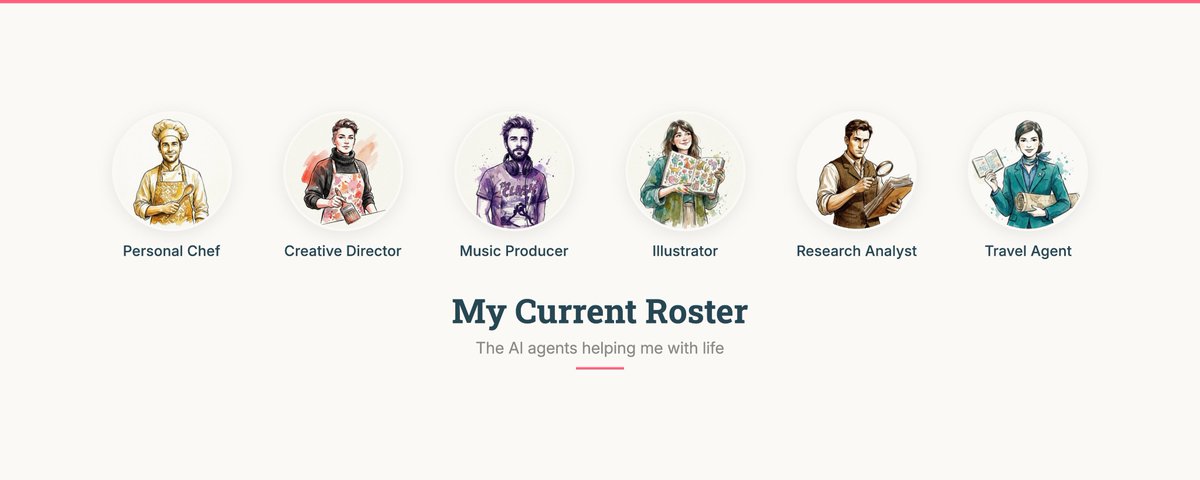
📝 The Dream Team I’ve Always Wanted Finally Feels Within Reach A few years ago, a TPM I worked with used to prompt Gemini with a funny, hypothetical scenario: "Assume I have unlimited money. How would I run my life more effectively?" It turns out that people with unlimited resources don't just work harder; they outsource. They hire specialists. They have a chef, a personal assistant, a creative director, a music tutor, and a financial advisor. They build a team. Today, looking at my life - three kids four and under, a job in tech, a husband who commutes, a dog, a cat, and a desire to actually see my friends in San Francisco - it’s easy to see why a team of specialists feels like a superpower. But recently, I had a realization: that "billionaire" operating model is finally within reach. Not because I won the lottery, but because the promise of AI agents is finally starting to feel real. I’ve been pushing the limits of what’s possible with my own custom agent framework, "Lulubot" (built on OpenClaw). Through a dozen side projects, I’ve realized that I don't want a single, omniscient bot. I want a staff. Here is how I’m building my dream team, and where I think the product landscape needs to go to support it. The Dream Team (MVP) My goal is simple: outsource as much as possible so I can spend time on what I enjoy. My current ideal roster includes: The Core Operations Chief of Staff (Lulubot): My first point of contact. The traffic controller for my life that triages requests, routes tasks, and unblocks me when I don't know where to start. Research Analyst: For when I need to go a level deeper than a Google search. It synthesizes complex topics into executive summaries. Morning Briefings: My personal news anchor. Delivers a curated overview of exactly what I’m interested in, straight to my inbox every morning. Morning Surprise: A "Director of Fun" that generates daily mini-apps to add a spark of delight to the start of my day. Life & Logistics Personal Chef: Solves the 5:00 PM "what's for dinner?" panic. It manages meal planning, and optimizes grocery runs. Travel Agent: Helping me plan our family trip to Canada this summer, from flights to toddler-friendly itineraries. Thoughtful Ops: My personal CRM. It tracks birthdays, suggests thoughtful gifts, and ensures I actually send those holiday cards this year. Personal Health: From tracking fitness goals to optimizing health regimens, and holding me accountable on things I should be doing! Personal Stylist: Because I want a curated wardrobe I love, but I have zero time to scour the internet for what is currently in style. Creative Studio Creative Director: The guardian of my brand. It manages assets for "Thursday Thoughts," generates quote cards, and ensures visual consistency. Content Strategist: My brainstorming partner. It researches angles for future posts and handles the heavy lifting of repurposing content across different platforms. Illustrator: A specialized image generator helping me build custom coloring books - starting with a Yosemite-themed edition. Musical Director: A technical producer that bridges the gap between my ideas and execution - currently helping me produce a track called "Purple Urple" with my 4-year-old. The "Labs" Department The Day Trader: Because... well, what if AI could day trade? (Strictly experimental!) Some of these are functional; others are aspirational, and there’s more that I am sure I’ll want to add. But the ones that work are changing how I live and create. Here is what that looks like in practice. 1. The Personal Chef: From Chat to Utility I love cooking, but at 5:45 PM on a Tuesday, I am exhausted. I used to fall into a rut of DoorDash simply because I didn't have the brain space to inventory my fridge and plan ahead. I asked Lulubot to help me land on 10 "go-to" recipes - sheet pan gnocchi, chicken tacos - that take less than 30 minutes. But I quickly realized that a chat log is a terrible place to store a meal plan. I wanted to see the food. So, I had the agent help me build a custom web app. I then iterated on the app with the agent. Now, it creates grocery lists based on the meals I select, dedupes the ingredients, and scales portions. It’s not a chat log anymore; it’s a living utility that feels like my personal chef. 2. The Creative Director: The Power of Multi-Surface Collaboration I’ve always wanted to make a custom coloring book. In the past, I never had the patience to follow through. Using Lulubot as my Creative Director, we concepted 50 pages of Yosemite illustrations. I didn't draw them; I directed them. I offered feedback on the covers, but my agent did the heavy lifting of generating interesting facts for the pages, and formatting it for Amazon Kindle Direct Publishing (KDP). But here is where the "Chat" interface broke down. Trying to manage the state of a 50-page book in a linear chat stream is a nightmare. I’d lose track of which pages were finished, and if I wanted to do something like crop an image, explaining it in text ("crop the top left a bit") was tedious compared to a one click “crop” button. So, I had the agent help me build a custom web app to manage the project. The breakthrough wasn't moving away from chat - it was using chat and the Web App together. It wasn't an "either/or" situation. I ended up with a multi-surface collaboration. In the Chat: I used the conversational interface for high-level creative tasks like designing the cover page, and—crucially—for the coding tasks to add more features to the web app itself. In the Web App: I could visually edit and approve the coloring book pages, organize the layout, and keep track of the overall book's completion as it got built. The app provided the context and state, while the chat provided the instruction and creation. (Side note: My daughter was so excited that she couldn't wait for the print version. So, I had the agent spin up a "view-only" mode on an iPad web app. She flips through "Yosemite Calling" on her screen, happy as a clam. I moved from being a creator to a manager, directing a junior designer who works at light speed.) 3. The Music Producer: The Magic of Tool Use My four-year-old is obsessed with the song "Mellow Yellow," so we decided to rewrite it as "Purple Urple." Previously, this project was a graveyard of good intentions. The workflow was a nightmare: recording a toddler in fragments, emailing files to myself, manually slicing audio in iMovie, and trying to line up timing. It was thankless work. Worse, I hit a hard technical wall. I needed an instrumental version of the song, but I didn't know how to strip the vocals from the original track. That one blocker killed the project every time. This time, I didn't edit; I acted as the producer. I had my agent download an open-source vocal remover tool (Ultimate Vocal Remover). The agent stripped the vocals from the original track to create a karaoke version. I sent voice memos of my daughter singing the new lyrics. The agent trimmed the clips and lined them up to the backing track. The breakthrough: I still don't know how to use the Ultimate Vocal Remover tool on GitHub. But I don't need to know. I just need an agent that knows how to use the tool when I give the command. Topline Observations: The Playbook for the Future Building this team has been messy, chaotic, and utterly game-changing. As I push Lulubot to its limits, a few core truths about the future of AI products are becoming more clear. 1. Reset Expectations: It Doesn’t Have to be Perfect to be Magic Let’s be real: none of these agents work perfectly 100% of the time. I literally had to hard-reset my entire system this weekend because it broke. But we need to change how we measure value. An agent doesn't need to automate the entire process to be transformative. The Reality: My Creative Director didn't upload the book to Amazon for me. I still had to click the buttons. The Value: It packaged everything up - the files, the metadata, the descriptions - and emailed it to me as a perfect little bundle. Most of my interaction happens on my phone via voice, but the "finishing touches" happen on my computer. If an agent can get me 90% of the way there and hand off the baton cleanly, that is still a superpower. 2. What is an Agent? (The "Folder" Analogy) We struggle to define what an agent actually is and where the boundaries of one end and the next begin. The best mental model I’ve found is this: Agents are the new Folders. In the old world, folders helped us organize static files so we remembered where to look for things. In this new world, agents are folders that can take action. The Agents: Specialized containers for specific tasks and contexts. The Chief of Staff: The "Search Bar" or OS that sits on top of them all. I expect everyone will want to customize their own "folder structure." I split my Creative Director and Illustrator into two roles; someone else might merge them. The structure of the team is personal, just like your file system. 3. The Architecture of a Team: Context Bounding This is the biggest technical and product insight I’ve had. Right now, most systems dump everything into one giant memory file. That has drawbacks (and might be a mistake). In the real world, my gardener doesn't see my tax returns. We need to build permissioning and compartmentalization into the OS of these agents. My Finance Agent needs my bank details; my PTA Agent absolutely does not. My Brand Agent needs my professional style guide; I don't want that bleeding into my Yosemite coloring book aesthetic. Context bounding solves four major problems: Quality: It stops unintentional bleed-over. For example: users have complained about ChatGPT’s memory feature inserting personal details where they don't belong. “I don't need my 'Research Analyst' to mention my 4-year-old’s favorite song when I'm asking for a summary of a complex geopolitical situation. It’s not just unhelpful; it’s jarring.” [link] User Experience: Instant Context vs. The Jumbled Stream. Right now, my interactions are jumbled. I’ll be fixing a code block for a carousel generator and then suddenly have to ask, "Wait, can you also update the grocery list?" It’s messy. The future isn’t a single chat stream; it’s a framework in which agents live where they are useful. When I open my "Thursday Thoughts" Creative Director agent, I’m instantly in a Professional Mindset. I can use shorthand like "Make this pop," and it knows to bold the font. If I say that to my Illustrator Agent, it knows to add sparkles to the coloring page. I don't have to explain who I am every time; the agent meets me where I am. Trust: I am comfortable using an agent if I know it has "least privileged" access. I’ll let a Creative Agent help me today because it doesn't touch my bank account. Over time, I might grant more access, but only if I know the lanes are secure. Fun: We crave variety. I want my Personal Coach to be an upbeat hype-man. If that same "GO GET 'EM!" energy came out of my kids' Tutor agent, it would be jarring. Different team members should feel like different people. 4. The "Black Box" Problem Right now, we are stuck between raw code and a blank chat box - with .md files now acting as the “in-between.” As a prosumer, I want to see under the hood without reading markdown files. This could be a dashboard or a Team Site - something that says: "Here is your Finance Agent. It has access to these three APIs, these two folders, and this specific goal. Oh and this is what it’s working on for you right now…" This is the ultimate product unlock for the next generation of AI agents: What is the interface for the everyday user? 5. The Shift: From Chat to Product We assume that because an interaction starts as a chat, it must stay a chat. My experience with the Recipe App and the Coloring Book showed that sometimes conversation is just the interface for instruction. The output should often be a product - a web app, a PDF, a filled-out form, or a calendar invite. I’ve found myself building custom interfaces just to interact with my agents better. We need to break out of the chat box. At the same time, chat will continue to be helpful - this isn’t an either/or situation. The Dream Team is Within Reach My creative output has skyrocketed not because I have more time, but because I have a staff. I have a team that handles the heavy lifting so I can focus on the vision. We need to build products that recognize this shift. The technology is already here; we just need to assemble the team. http://x.com/i/article/20245091857242071…

Topics
Read the stories that matter.The stories and ideas that actually matter.
Save hours a day in 5 minutesTurn hours of scrolling into a five minute read.