Press Space to continue
Evals should decide whether to fold subagents into agent loops
Press Space to continue

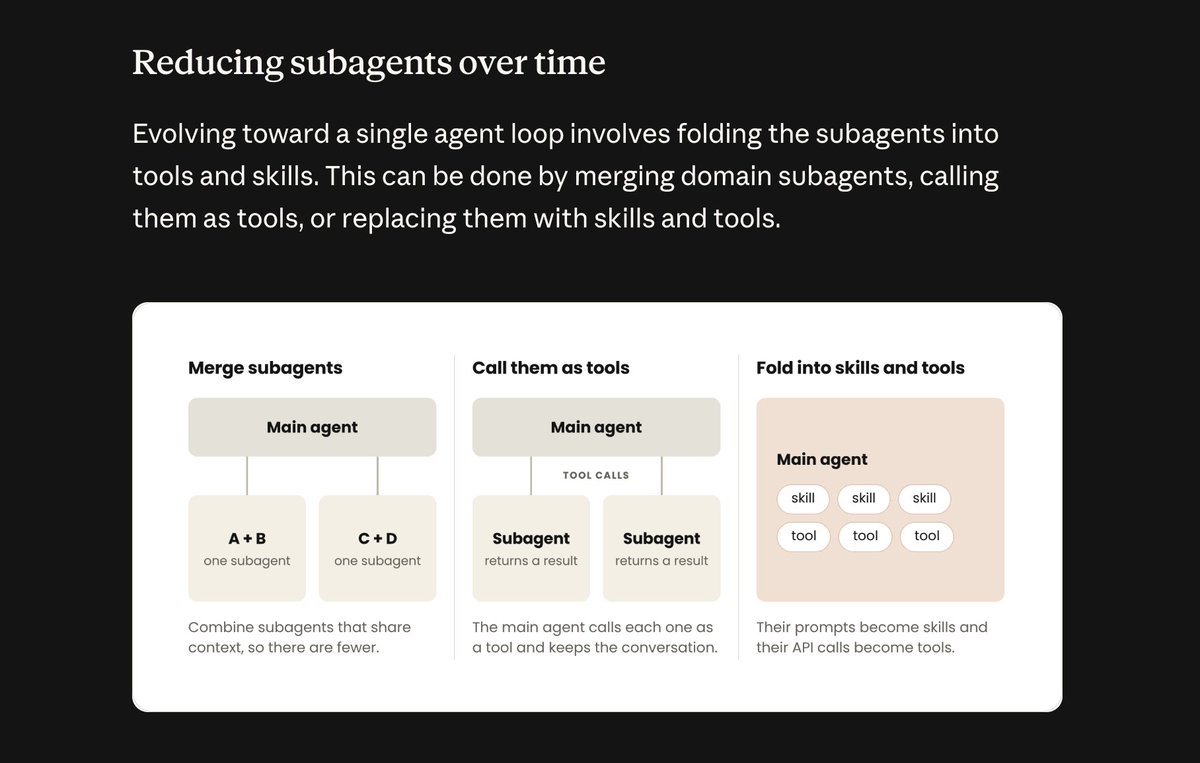
Banger guide by Anthropic. While frontier models have improved at context management, subagents still help in some cases (e.g., parallelizing research tasks with their own context windows). I still use them, but mostly for complex research work via dynamic workflows and /goal. For most agent workflows, folding subagents into the main loop via tool calls and skills makes a ton of sense (as Anthropic recommends). That's because newer models are more persistent and better at managing large…
cherry_mx_reds@cherry_mx_reds12h ago
Anthropic is now recommending that companies REMOVE unnecessary subagents from their AI systems. This is a pretty significant shift in agent architecture, with their team finding that a single agent equipped with skills can frequently outperform complex multi-agent systems, and one customer seeing roughly 2x faster execution. The emerging rules of thumb: → Skills: Teach the agent HOW to do something, including procedures, expertise, and instructions. → Tools / MCP: Give the agent the ability to DO things through APIs, actions, and live data. → Subagents: Use for parallel work, isolated context, or tasks a single agent struggles with. The interesting part is progressive disclosure. Instead of spawning specialized agents or stuffing everything into a giant prompt, one agent discovers and loads skills and tools as needed. Their advice is to fold existing subagents into the main loop, turn their instructions into skills, expose their actions as tools, and run evals to see if performance holds up. As models have gotten smarter, improving agent architecture is becoming less about what you can add and more about what you can delete. https://t.co/DNq60Skkmc