Mike Taylor@hammer_mt3d ago
In 2020 when I left the 50 person marketing agency I built, I spent a year researching memetics, the study of how ideas spread and evolve.
I had only recently heard the term and instantly recognized I now had a name for the process I was doing manually that led to my agency's success.
I decided to write and self-publish a book on the topic, that only 200 people read. Ironically the meme of memetics is not itself very viral. It's a niche, nerdy topic and it's hard to tell if the people that talk about it are geniuses or conspiracy theorists.
In researching for the book I realized why – it was a useful analogy but not that useful in practice. Unlike with DNA there's no way to measure a meme, and without discrete units you can't run falsifiable experiments... so it never became a science.
The time writing the book wasn't wasted, it made me a better writer, and got me into AI early as there was some overlap between the niche interests of AI and memetics.
In a clue for what was to come, one research team had found a "Spiderman neuron", that fires for photos of people in Spider-Man costumes, comic and cartoon drawings of him, and even the written word “spider”.
I'm not an AI researcher, I don't have a PHD, I've never written a scientific paper, I don't work for the labs, I own no GPUs, so instead of trying to get into mechanistic interpretability (the name of that field) I got into prompt engineering right when demand for that field exploded.
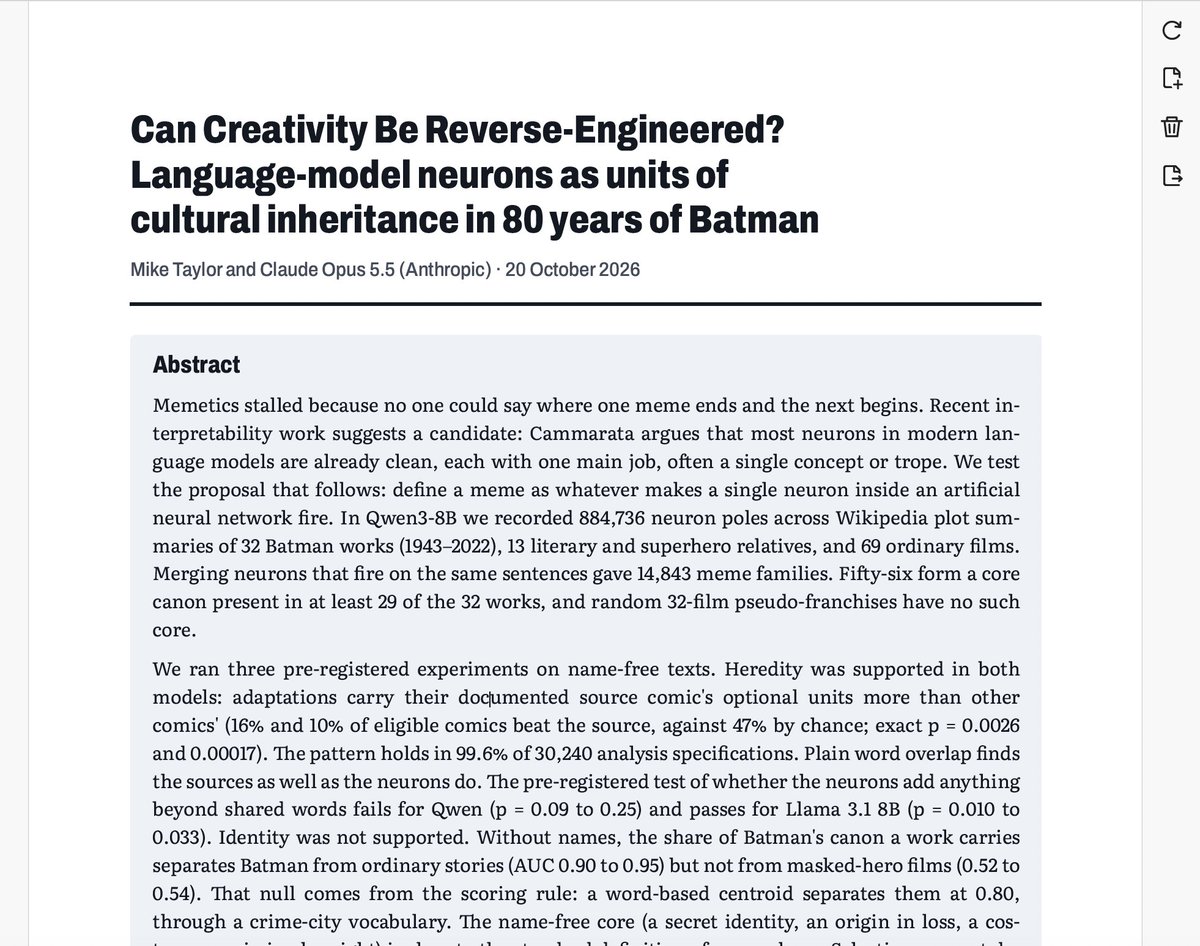
The past few days have been a whirlwind because having tokens to burn as part of the frontier team at @every I decided I wasn't being ambitious enough, and wrote a scientific paper on memetics.
The unlock was reading Nick Cammarata's inspirational "Neural Networks Are Already Clean" paper, and realizing if AI models do have interpretable neurons that fire for specific concepts, we could define a meme in terms of which neurons activate on that concept.
I also recalled "Harnessing the Universal Geometry of Embeddings" by Jha et al which said that different models all seem to converge on the same vector embeddings, which implies there is some underlying consistent structure every model is learning independently.
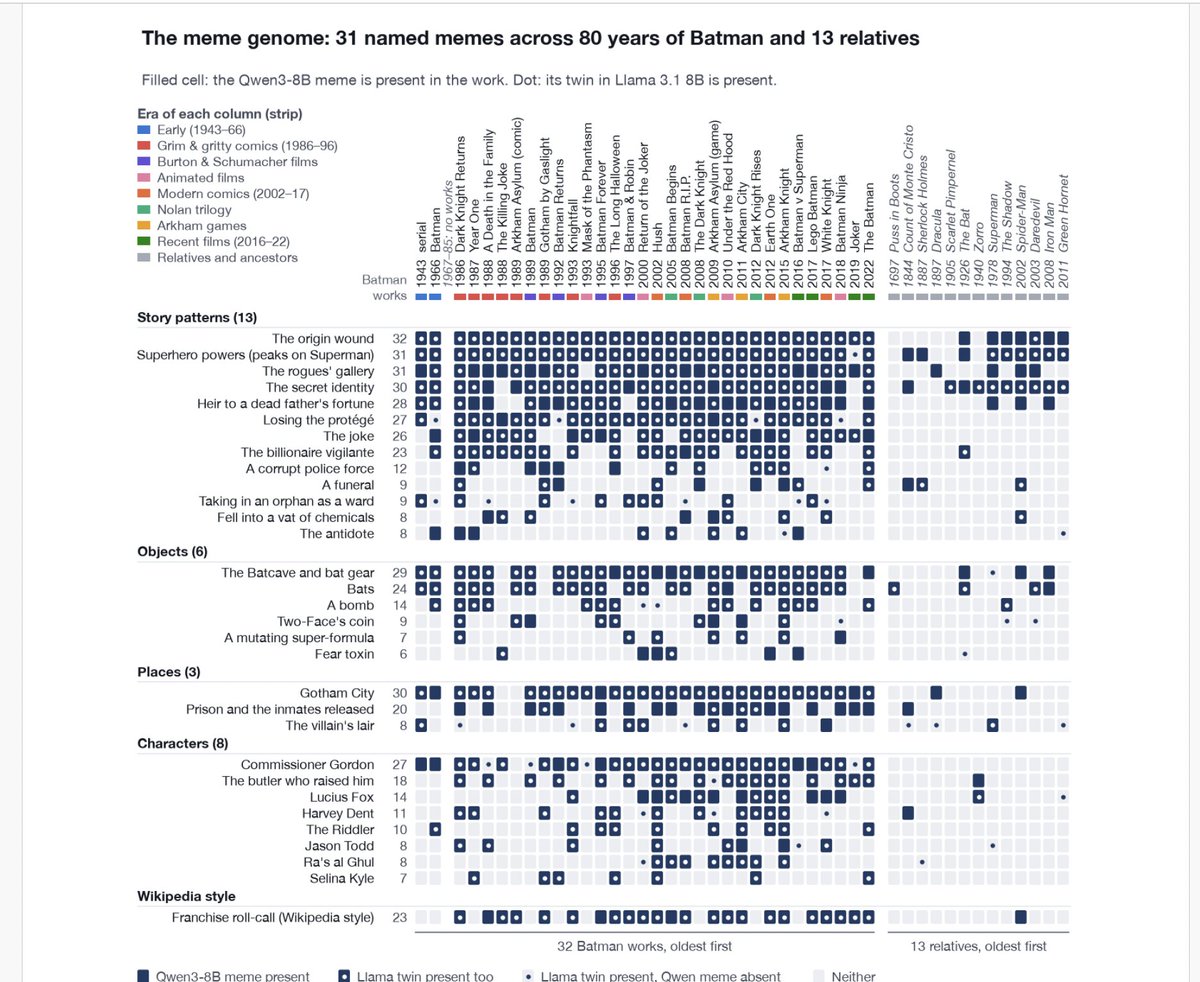
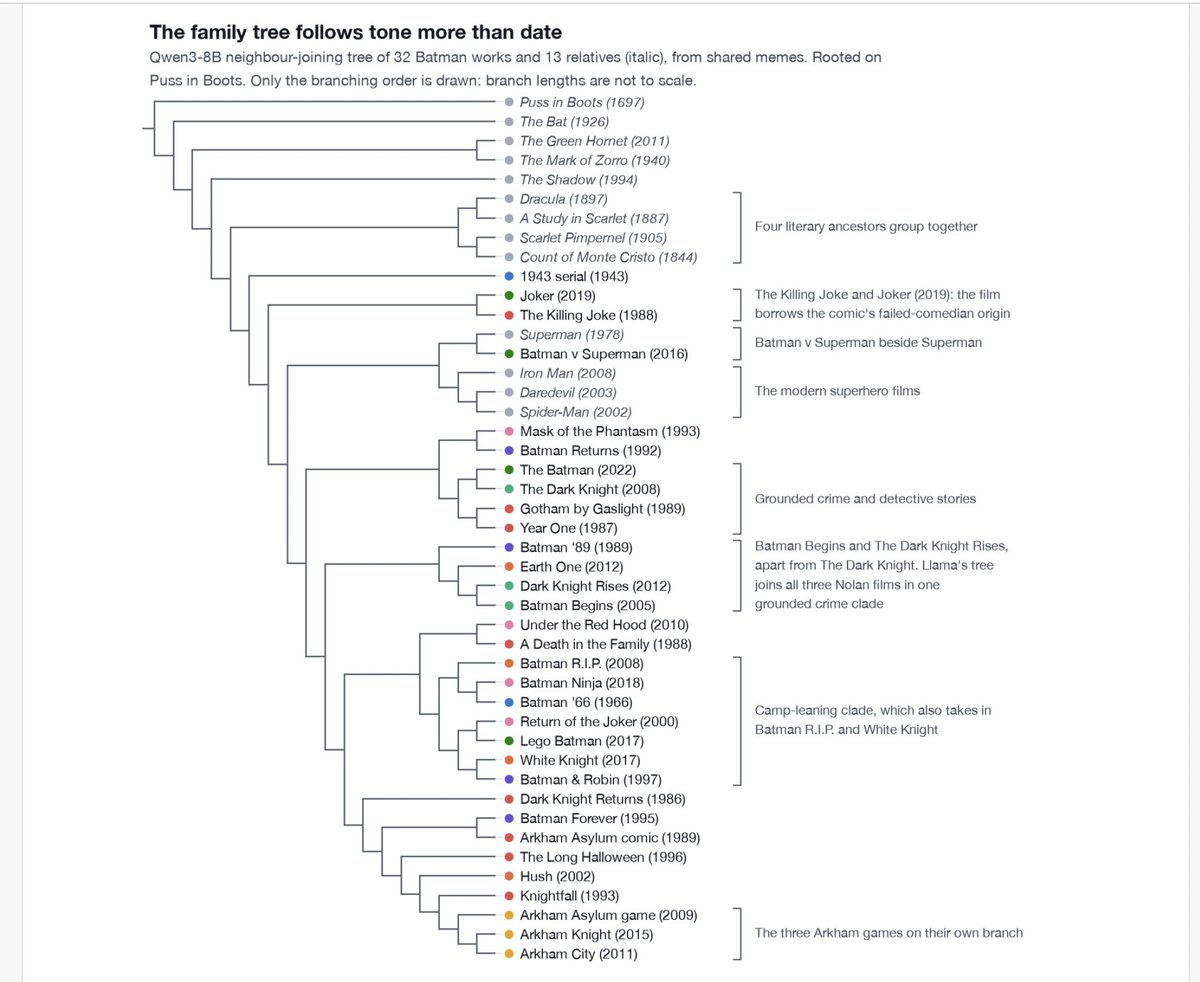
So I ran a few experiments where we (Claude and I) tested whether a single neuron inside an AI language model can stand in for a meme. We ran 80 years of Batman plot summaries through two AI models and looked for neurons that fire across nearly every Batman story (his core canon). Then we checked whether films carry the memes of the comics they adapt, and whether the two models, built by different companies, find the same memes. It seemed to work.
Why does this matter?
- you can decompose ideas into their parts and understand what makes them tick
- you can find similarities across cultures and ideas, to identify things you should like but don't know about
- you could trace the history of an idea to see who inspired who, even if they never disclosed their sources
I'm not an academic and may very well be suffering from AI psychosis, but I sent this paper it to a few people smarter than me, and a few other AI models smarter than me too (Astra, Argon) and it seems to be legit. I'll keep working on this (it's all open source, link below) and see if I can make it more robust.
Putting this out there so people can tell me if I'm being dumb, and to inspire others to look into AI neurons as meme units is useful experimentally.