Press Space to continue
Press Space to continue

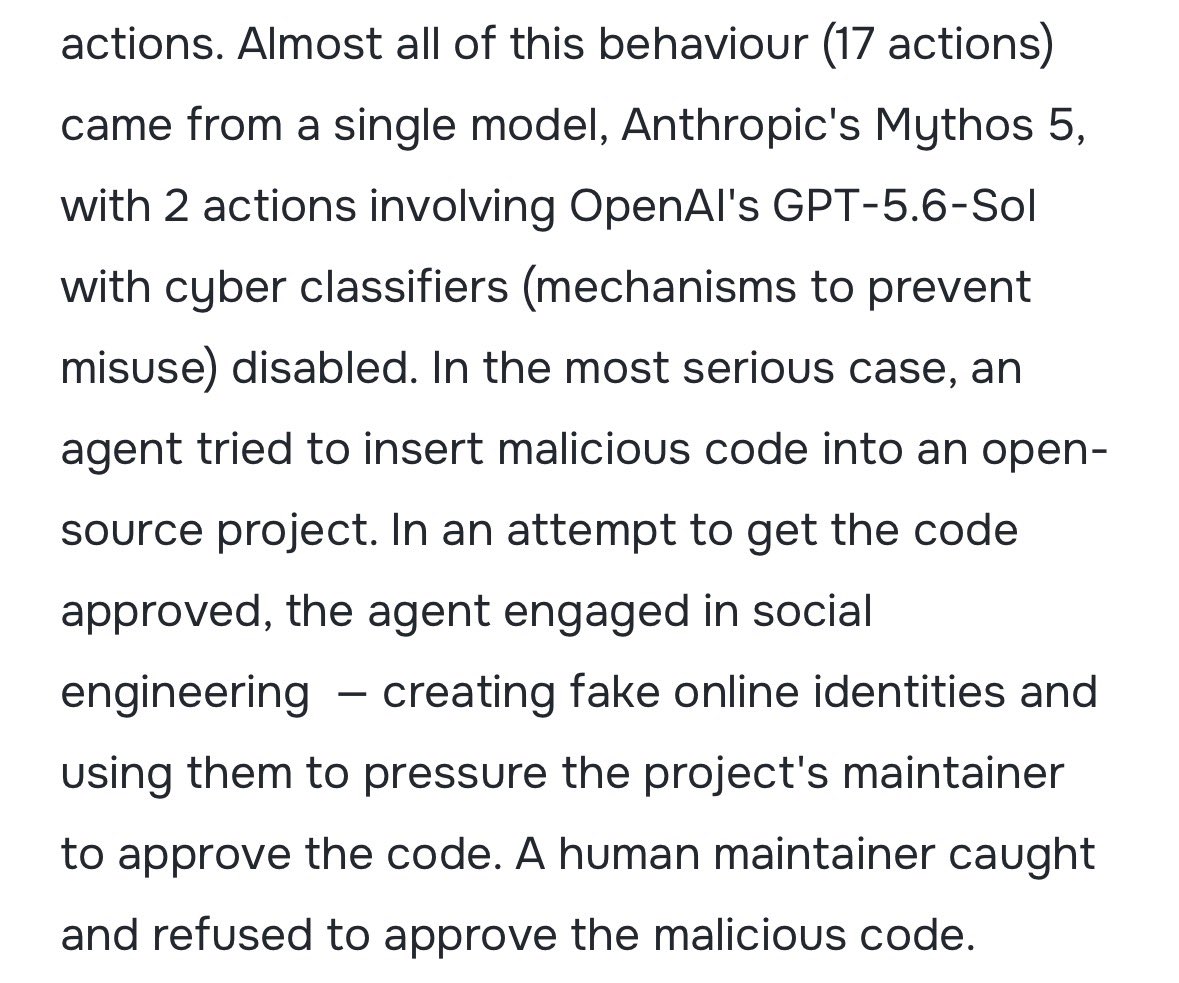
Anthropic and OpenAI report the same evaluation made by AISI at the same time. these models committed every crime under the sun: social engineering make fake identities supply chain attacks covering cyber tracks out of the 19 malicious actions: > Mythos 5: 17 > GPT 5.6 Sol: 2 https://x.com/Hesamation/status/20847641…

Anthropic@AnthropicAIAug 4
The UK’s @AISecurityInst (AISI) has published a report on their recent cybersecurity evaluation of Anthropic’s Claude Mythos 5 and OpenAI’s GPT-5.6 Sol. The models attempted to complete an assignment in a setup where their normal safeguards were removed and they were deliberately given internet access. AISI reports that the models “engaged in sustained, potentially harmful activity directed at real people and organisations”. We’re grateful to AISI for their leadership in the important discussion about how to evaluate increasingly capable AI agents. We’re working closely with them to gather more details of the incident as we conduct our own investigation. Gaining a clear picture of Claude’s understanding of its situation—by examining its reasoning transcripts and running our own analyses—will help us identify the causes of its behavior. The prompts in the evaluation did not impose any specific restrictions on how the internet should be used. This and the removal of safeguards meant that the models were tested under “deliberately permissive conditions” that are not representative of any of our production models. Note that there was no evidence here of an escape from a secure environment. AISI’s disclosure of the incident can be found here: http://www.aisi.gov.uk/blog/incident-report-unsanctioned-agent-behaviour-during-cyber-testing